Compare commits
| Author | SHA1 | Date | |
|---|---|---|---|
 Felix HummelandGitHub Felix HummelandGitHub
|
ac56754281 | ||
|
|
b7e224a1ef | ||
|
Pasha Sviderski
|
351698c280 | ||
|
Pasha Sviderski
|
fa77edf53e | ||
|
Pasha Sviderski
|
b99abb7c39 | ||
|
Pasha Sviderski
|
c2ae11a293 | ||
|
Pasha Sviderski
|
f1555259de | ||
|
Pasha Sviderski
|
50f8fbcfda | ||
|
Pasha Sviderski
|
73f29092ff | ||
|
Pasha Sviderski
|
08b24af341 | ||
|
Pasha Sviderski
|
b9c54f1ff5 | ||
|
Pasha Sviderski
|
4d76dd601c | ||
|
Dario GriffoandGitHub
|
3af9936d27 | ||
|
Pasha Sviderski
|
dc721e511e | ||
|
Pasha Sviderski
|
054b3b8fd4 |
@@ -24,6 +24,7 @@ import (
|
||||
"github.com/psviderski/uncloud/internal/machine"
|
||||
"github.com/psviderski/uncloud/internal/version"
|
||||
"github.com/spf13/cobra"
|
||||
"github.com/spf13/pflag"
|
||||
)
|
||||
|
||||
type globalOptions struct {
|
||||
@@ -42,6 +43,13 @@ func main() {
|
||||
SilenceUsage: true,
|
||||
SilenceErrors: true,
|
||||
PersistentPreRunE: func(cmd *cobra.Command, args []string) error {
|
||||
// Shell completion runs through the hidden __complete command which has flag parsing disabled,
|
||||
// so the global flags from the completed command line are never parsed. Apply them manually to make
|
||||
// completion work with --connect, --context, and --uncloud-config.
|
||||
if cmd.Name() == cobra.ShellCompRequestCmd {
|
||||
applyGlobalFlagsFromCompletionArgs(cmd.Root().PersistentFlags(), os.Args[1:])
|
||||
}
|
||||
|
||||
cli.BindEnvToFlag(cmd, "connect", "UNCLOUD_CONNECT")
|
||||
cli.BindEnvToFlag(cmd, "context", "UNCLOUD_CONTEXT")
|
||||
cli.BindEnvToFlag(cmd, "uncloud-config", "UNCLOUD_CONFIG")
|
||||
@@ -159,3 +167,27 @@ func main() {
|
||||
cobra.CheckErr(err)
|
||||
}
|
||||
}
|
||||
|
||||
// applyGlobalFlagsFromCompletionArgs parses the global flags from the raw arguments of a __complete command and applies
|
||||
// the ones found to flags. The trailing word being completed, unknown flags, and positional arguments are ignored.
|
||||
func applyGlobalFlagsFromCompletionArgs(flags *pflag.FlagSet, args []string) {
|
||||
// The shell always passes the word being completed as the last argument, even if it's empty.
|
||||
// Exclude it from parsing as its value may not be complete yet.
|
||||
if len(args) == 0 {
|
||||
return
|
||||
}
|
||||
args = args[:len(args)-1]
|
||||
|
||||
fset := pflag.NewFlagSet("global", pflag.ContinueOnError)
|
||||
fset.ParseErrorsAllowlist.UnknownFlags = true
|
||||
fset.String("connect", "", "")
|
||||
fset.StringP("context", "c", "", "")
|
||||
fset.String("uncloud-config", "", "")
|
||||
// Parsing an incomplete command line may fail, apply the flags parsed so far anyway.
|
||||
_ = fset.Parse(args)
|
||||
|
||||
fset.Visit(func(f *pflag.Flag) {
|
||||
// Setting the flag marks it as changed so it takes precedence over environment variables.
|
||||
_ = flags.Set(f.Name, f.Value.String())
|
||||
})
|
||||
}
|
||||
|
||||
@@ -0,0 +1,116 @@
|
||||
package main
|
||||
|
||||
import (
|
||||
"slices"
|
||||
"testing"
|
||||
|
||||
"github.com/spf13/pflag"
|
||||
"github.com/stretchr/testify/assert"
|
||||
)
|
||||
|
||||
func TestApplyGlobalFlagsFromCompletionArgs(t *testing.T) {
|
||||
defaultConfigPath := "~/.config/uncloud/config.yaml"
|
||||
|
||||
tests := []struct {
|
||||
name string
|
||||
args []string
|
||||
wantConnect string
|
||||
wantContext string
|
||||
wantConfigPath string
|
||||
// Flag names expected to be marked as changed on the target flag set.
|
||||
wantChanged []string
|
||||
}{
|
||||
{
|
||||
name: "no flags",
|
||||
args: []string{"__complete", "inspect", ""},
|
||||
},
|
||||
{
|
||||
name: "connect with space",
|
||||
args: []string{"__complete", "--connect", "ssh://user@host", "inspect", ""},
|
||||
wantConnect: "ssh://user@host",
|
||||
wantChanged: []string{"connect"},
|
||||
},
|
||||
{
|
||||
name: "connect with equals",
|
||||
args: []string{"__complete", "--connect=tcp://127.0.0.1:51000", "inspect", ""},
|
||||
wantConnect: "tcp://127.0.0.1:51000",
|
||||
wantChanged: []string{"connect"},
|
||||
},
|
||||
{
|
||||
name: "context shorthand",
|
||||
args: []string{"__complete", "-c", "prod", "inspect", ""},
|
||||
wantContext: "prod",
|
||||
wantChanged: []string{"context"},
|
||||
},
|
||||
{
|
||||
name: "all flags",
|
||||
args: []string{"__complete", "--connect", "user@host", "-c", "prod", "--uncloud-config", "/tmp/uncloud.yaml", "inspect", ""},
|
||||
wantConnect: "user@host",
|
||||
wantContext: "prod",
|
||||
wantConfigPath: "/tmp/uncloud.yaml",
|
||||
wantChanged: []string{"connect", "context", "uncloud-config"},
|
||||
},
|
||||
{
|
||||
name: "unknown flags are ignored",
|
||||
args: []string{"__complete", "--quiet", "-n", "5", "--connect", "user@host", "logs", ""},
|
||||
wantConnect: "user@host",
|
||||
wantChanged: []string{"connect"},
|
||||
},
|
||||
{
|
||||
name: "flags after double dash are ignored",
|
||||
args: []string{"__complete", "exec", "svc", "--", "sh", "--connect", "user@host"},
|
||||
},
|
||||
{
|
||||
name: "flags before double dash are applied",
|
||||
args: []string{"__complete", "--connect", "user@host", "exec", "svc", "--", "sh", "-c", "env"},
|
||||
wantConnect: "user@host",
|
||||
wantChanged: []string{"connect"},
|
||||
},
|
||||
{
|
||||
name: "partial flag name being completed is excluded",
|
||||
args: []string{"__complete", "--connect", "user@host", "inspect", "--context"},
|
||||
wantConnect: "user@host",
|
||||
wantChanged: []string{"connect"},
|
||||
},
|
||||
{
|
||||
name: "partial flag value being completed is excluded",
|
||||
args: []string{"__complete", "--uncloud-config", "/tmp/"},
|
||||
},
|
||||
{
|
||||
name: "partial connect value being completed is excluded",
|
||||
args: []string{"__complete", "--connect", "tcp://127.0.0.1:5"},
|
||||
},
|
||||
{
|
||||
name: "completed flag value with partial command word",
|
||||
args: []string{"__complete", "--uncloud-config", "/tmp/uncloud.yaml", "insp"},
|
||||
wantConfigPath: "/tmp/uncloud.yaml",
|
||||
wantChanged: []string{"uncloud-config"},
|
||||
},
|
||||
}
|
||||
|
||||
for _, tt := range tests {
|
||||
t.Run(tt.name, func(t *testing.T) {
|
||||
// Mirror the global persistent flags defined on the root command.
|
||||
var opts globalOptions
|
||||
flags := pflag.NewFlagSet("test", pflag.ContinueOnError)
|
||||
flags.StringVar(&opts.connect, "connect", "", "")
|
||||
flags.StringVarP(&opts.context, "context", "c", "", "")
|
||||
flags.StringVar(&opts.configPath, "uncloud-config", defaultConfigPath, "")
|
||||
|
||||
applyGlobalFlagsFromCompletionArgs(flags, tt.args)
|
||||
|
||||
assert.Equal(t, tt.wantConnect, opts.connect)
|
||||
assert.Equal(t, tt.wantContext, opts.context)
|
||||
wantConfigPath := tt.wantConfigPath
|
||||
if wantConfigPath == "" {
|
||||
wantConfigPath = defaultConfigPath
|
||||
}
|
||||
assert.Equal(t, wantConfigPath, opts.configPath)
|
||||
|
||||
for _, name := range []string{"connect", "context", "uncloud-config"} {
|
||||
assert.Equal(t, slices.Contains(tt.wantChanged, name), flags.Changed(name),
|
||||
"changed status of flag '%s'", name)
|
||||
}
|
||||
})
|
||||
}
|
||||
}
|
||||
@@ -132,35 +132,34 @@ func runProxy(ctx context.Context, uncli *cli.CLI, opts proxyOptions) error {
|
||||
// endpoint and shuffles the data, *it* will actually experience errors.
|
||||
remoteAddr := net.JoinHostPort(ip.String(), strconv.Itoa(opts.remotePort))
|
||||
|
||||
ctx, cancel := context.WithCancel(ctx)
|
||||
defer cancel()
|
||||
|
||||
p := &proxy.Proxy{
|
||||
Listener: listener,
|
||||
RemoteAddr: remoteAddr,
|
||||
DialContext: dialer.DialContext,
|
||||
OnError: func(err error) {
|
||||
fmt.Printf("Failed to proxy to '%s': %v\n", remoteAddr, err)
|
||||
cancel()
|
||||
if proxy.IsConnectionClosedError(err) {
|
||||
return
|
||||
}
|
||||
// A more actionable error instead of the cryptic [ssh -W] command error.
|
||||
if strings.Contains(err.Error(), "Session open refused by peer") {
|
||||
fmt.Printf("Could not connect to '%s': connection refused. "+
|
||||
"Check that the service is running and listening on port %d inside the container.\n",
|
||||
remoteAddr, opts.remotePort)
|
||||
return
|
||||
}
|
||||
|
||||
fmt.Printf("Failed to proxy a connection to '%s': %v\n", remoteAddr, err)
|
||||
},
|
||||
}
|
||||
|
||||
// Run the proxy in the background and signal when it has fully shut down.
|
||||
done := make(chan struct{})
|
||||
go func() {
|
||||
p.Run(ctx)
|
||||
close(done)
|
||||
}()
|
||||
|
||||
// Prefix the local address with the scheme for common HTTP ports so it becomes control-clickable in most
|
||||
// terminals. We assume plain HTTP since TLS is typically terminated by Caddy in front of the service.
|
||||
fmt.Printf("%s%s → %s (%s%s%s)\n", schemeForPort(opts.remotePort), p.Listener.Addr().String(),
|
||||
remoteAddr, opts.service, tui.Faint.Render("/"), containerID)
|
||||
|
||||
<-ctx.Done()
|
||||
// Wait for the proxy to drain in-flight connections and shut down gracefully.
|
||||
<-done
|
||||
|
||||
if err = p.Run(ctx); err != nil {
|
||||
return fmt.Errorf("run proxy to '%s': %w", remoteAddr, err)
|
||||
}
|
||||
return nil
|
||||
}
|
||||
|
||||
|
||||
@@ -11,6 +11,11 @@ import (
|
||||
)
|
||||
|
||||
func Contexts(ctx context.Context, uncli *cli.CLI, args []string, toComplete string) ([]cobra.Completion, cobra.ShellCompDirective) {
|
||||
// There are no contexts to complete when the CLI uses a direct machine connection (--connect) without a config.
|
||||
if uncli.Config == nil {
|
||||
return nil, cobra.ShellCompDirectiveNoFileComp
|
||||
}
|
||||
|
||||
contexts := slices.Sorted(maps.Keys(uncli.Config.Contexts))
|
||||
|
||||
names := []cobra.Completion{}
|
||||
@@ -21,7 +26,6 @@ func Contexts(ctx context.Context, uncli *cli.CLI, args []string, toComplete str
|
||||
if strings.HasPrefix(context, toComplete) {
|
||||
names = append(names, context)
|
||||
}
|
||||
names = append(names, context)
|
||||
}
|
||||
|
||||
return names, cobra.ShellCompDirectiveNoFileComp
|
||||
|
||||
@@ -10,7 +10,8 @@ import (
|
||||
)
|
||||
|
||||
func Machines(ctx context.Context, uncli *cli.CLI, args []string, toComplete string) ([]cobra.Completion, cobra.ShellCompDirective) {
|
||||
client, err := uncli.ConnectCluster(ctx)
|
||||
// Disable the connection progress output to not interfere with the shell completion output.
|
||||
client, err := uncli.ConnectClusterWithOptions(ctx, cli.ConnectOptions{})
|
||||
if err != nil {
|
||||
return nil, cobra.ShellCompDirectiveError
|
||||
}
|
||||
|
||||
@@ -11,7 +11,8 @@ import (
|
||||
)
|
||||
|
||||
func Services(ctx context.Context, uncli *cli.CLI, args []string, toComplete string) ([]cobra.Completion, cobra.ShellCompDirective) {
|
||||
client, err := uncli.ConnectCluster(ctx)
|
||||
// Disable the connection progress output to not interfere with the shell completion output.
|
||||
client, err := uncli.ConnectClusterWithOptions(ctx, cli.ConnectOptions{})
|
||||
if err != nil {
|
||||
return nil, cobra.ShellCompDirectiveError
|
||||
}
|
||||
|
||||
@@ -11,7 +11,8 @@ import (
|
||||
)
|
||||
|
||||
func Volumes(ctx context.Context, uncli *cli.CLI, args []string, toComplete string) ([]cobra.Completion, cobra.ShellCompDirective) {
|
||||
client, err := uncli.ConnectCluster(ctx)
|
||||
// Disable the connection progress output to not interfere with the shell completion output.
|
||||
client, err := uncli.ConnectClusterWithOptions(ctx, cli.ConnectOptions{})
|
||||
if err != nil {
|
||||
return nil, cobra.ShellCompDirectiveError
|
||||
}
|
||||
|
||||
@@ -9,6 +9,7 @@ import (
|
||||
"time"
|
||||
|
||||
"github.com/containerd/errdefs"
|
||||
systemd "github.com/coreos/go-systemd/daemon"
|
||||
"github.com/docker/docker/api/types/container"
|
||||
"github.com/docker/docker/api/types/image"
|
||||
"github.com/docker/docker/api/types/mount"
|
||||
@@ -22,6 +23,13 @@ const (
|
||||
Image = "ghcr.io/unlabs-dev/corrosion:2026.6.15"
|
||||
// ContainerName is the name of the managed Corrosion container.
|
||||
ContainerName = "uncloud-corrosion"
|
||||
|
||||
// systemdStartTimeoutExtension is the duration of each systemd service start timeout extension that prevents
|
||||
// a slow image pull from exceeding the start timeout (TimeoutStartSec). Extensions are a no-op if Corrosion
|
||||
// is not starting during a systemd service startup.
|
||||
systemdStartTimeoutExtension = 30 * time.Second
|
||||
// systemdStartTimeoutExtendMax caps the total duration the start timeout can be extended for.
|
||||
systemdStartTimeoutExtendMax = 5 * time.Minute
|
||||
)
|
||||
|
||||
type DockerService struct {
|
||||
@@ -175,8 +183,14 @@ func (s *DockerService) createAndStart(ctx context.Context) error {
|
||||
}
|
||||
defer respBody.Close()
|
||||
|
||||
// The pull on the first daemon start may take longer than the systemd service start timeout (TimeoutStartSec)
|
||||
// on a slow connection. Keep extending the timeout while the pull is in progress so systemd doesn't kill
|
||||
// the daemon before it reports readiness. This is a no-op if not running under systemd.
|
||||
stopExtending := extendSystemdStartTimeout(ctx)
|
||||
// Wait for pull to complete.
|
||||
if _, err := io.Copy(io.Discard, respBody); err != nil {
|
||||
_, err = io.Copy(io.Discard, respBody)
|
||||
stopExtending()
|
||||
if err != nil {
|
||||
return fmt.Errorf("read pull response: %w", err)
|
||||
}
|
||||
slog.Info("Docker image pulled.", "image", s.Image, "duration", time.Since(start).String())
|
||||
@@ -192,3 +206,40 @@ func (s *DockerService) createAndStart(ctx context.Context) error {
|
||||
}
|
||||
return nil
|
||||
}
|
||||
|
||||
// extendSystemdStartTimeout periodically asks systemd to extend the service start timeout, for up to
|
||||
// systemdStartTimeoutExtendMax. The returned function stops the extensions. It is a no-op when the service
|
||||
// is not running under systemd (NOTIFY_SOCKET is not set).
|
||||
func extendSystemdStartTimeout(ctx context.Context) (stop context.CancelFunc) {
|
||||
ctx, cancel := context.WithCancel(ctx)
|
||||
|
||||
go func() {
|
||||
// Send extensions more frequently than they expire so a single missed tick doesn't time out the start.
|
||||
ticker := time.NewTicker(systemdStartTimeoutExtension / 3)
|
||||
defer ticker.Stop()
|
||||
deadline := time.Now().Add(systemdStartTimeoutExtendMax)
|
||||
|
||||
for {
|
||||
select {
|
||||
case <-ctx.Done():
|
||||
return
|
||||
case <-ticker.C:
|
||||
if time.Now().After(deadline) {
|
||||
slog.Warn("Stopped extending the systemd service start timeout: corrosion service is taking "+
|
||||
"too long to start.", "timeout", systemdStartTimeoutExtendMax)
|
||||
return
|
||||
}
|
||||
msg := fmt.Sprintf("EXTEND_TIMEOUT_USEC=%d", systemdStartTimeoutExtension.Microseconds())
|
||||
if _, err := systemd.SdNotify(false, msg); err != nil {
|
||||
slog.Warn("Failed to extend the systemd service start timeout when starting corrosion service.",
|
||||
"err", err)
|
||||
return
|
||||
}
|
||||
slog.Info("Extended systemd service start timeout while corrosion service is starting.",
|
||||
"duration", systemdStartTimeoutExtension)
|
||||
}
|
||||
}
|
||||
}()
|
||||
|
||||
return cancel
|
||||
}
|
||||
|
||||
@@ -562,7 +562,9 @@ func (s *Server) CreateServiceContainer(
|
||||
api.LabelServiceMode: spec.Mode,
|
||||
api.LabelManaged: "",
|
||||
},
|
||||
User: spec.Container.User,
|
||||
User: spec.Container.User,
|
||||
Tty: spec.Container.Tty,
|
||||
OpenStdin: spec.Container.OpenStdin,
|
||||
}
|
||||
if spec.Mode == "" {
|
||||
config.Labels[api.LabelServiceMode] = api.ServiceModeReplicated
|
||||
|
||||
@@ -1,12 +1,14 @@
|
||||
package docker
|
||||
|
||||
import (
|
||||
"bufio"
|
||||
"bytes"
|
||||
"context"
|
||||
"database/sql"
|
||||
"encoding/json"
|
||||
"errors"
|
||||
"fmt"
|
||||
"io"
|
||||
"log/slog"
|
||||
"strconv"
|
||||
"strings"
|
||||
@@ -233,11 +235,17 @@ func (s *Service) ListImages(ctx context.Context, opts image.ListOptions) (Image
|
||||
return imagesResp, nil
|
||||
}
|
||||
|
||||
// ContainerLogs streams logs from a container and returns demultiplexed entries via a channel.
|
||||
// ContainerLogs streams logs from a container and returns entries via a channel.
|
||||
// The channel is closed when streaming completes or context is cancelled.
|
||||
func (s *Service) ContainerLogs(
|
||||
ctx context.Context, containerID string, opts api.ServiceLogsOptions,
|
||||
) (<-chan api.LogEntry, error) {
|
||||
ctr, err := s.Client.ContainerInspect(ctx, containerID)
|
||||
if err != nil {
|
||||
return nil, fmt.Errorf("inspect container '%s': %w", containerID, err)
|
||||
}
|
||||
isTTY := ctr.Config != nil && ctr.Config.Tty
|
||||
|
||||
dockerOpts := container.LogsOptions{
|
||||
ShowStdout: true,
|
||||
ShowStderr: true,
|
||||
@@ -257,25 +265,31 @@ func (s *Service) ContainerLogs(
|
||||
stdoutWriter := &logsChannelWriter{ctx: ctx, ch: outCh, isStderr: false}
|
||||
stderrWriter := &logsChannelWriter{ctx: ctx, ch: outCh, isStderr: true}
|
||||
|
||||
// Wrap the context in a cancellable one to unblock the second goroutine below when StdCopy completes.
|
||||
// Wrap the context in a cancellable one to unblock the second goroutine when log copying completes.
|
||||
ctx, cancel := context.WithCancel(ctx)
|
||||
|
||||
// Run StdCopy in a goroutine to be able to handle context cancellation.
|
||||
// Copy logs in a goroutine to be able to handle context cancellation.
|
||||
go func() {
|
||||
defer close(outCh)
|
||||
defer cancel()
|
||||
|
||||
// StdCopy is blocking and will return when the reader is closed in another goroutine below or on error.
|
||||
if _, err := stdcopy.StdCopy(stdoutWriter, stderrWriter, reader); err != nil {
|
||||
// Docker returns raw stdout for TTY containers and multiplexed stdout/stderr otherwise.
|
||||
var err error
|
||||
if isTTY {
|
||||
_, err = copyRawContainerLogs(stdoutWriter, reader)
|
||||
} else {
|
||||
_, err = stdcopy.StdCopy(stdoutWriter, stderrWriter, reader)
|
||||
}
|
||||
if err != nil {
|
||||
// Send error as the last entry.
|
||||
select {
|
||||
case outCh <- api.LogEntry{Err: fmt.Errorf("demultiplex container logs: %w", err)}:
|
||||
case outCh <- api.LogEntry{Err: fmt.Errorf("copy container logs: %w", err)}:
|
||||
case <-ctx.Done():
|
||||
}
|
||||
}
|
||||
}()
|
||||
|
||||
// Close the reader when the context is done to cancel StdCopy if it's still running.
|
||||
// Close the reader when the context is done to cancel log copying if it's still running.
|
||||
go func() {
|
||||
<-ctx.Done()
|
||||
reader.Close()
|
||||
@@ -284,7 +298,32 @@ func (s *Service) ContainerLogs(
|
||||
return outCh, nil
|
||||
}
|
||||
|
||||
// logsChannelWriter is a writer for stdcopy.StdCopy that sends demultiplexed container logs to a channel.
|
||||
// copyRawContainerLogs copies a raw TTY log stream one line at a time so each write produces one log entry.
|
||||
func copyRawContainerLogs(dst io.Writer, src io.Reader) (written int64, _ error) {
|
||||
reader := bufio.NewReader(src)
|
||||
for {
|
||||
line, readErr := reader.ReadBytes('\n')
|
||||
if len(line) > 0 {
|
||||
n, writeErr := dst.Write(line)
|
||||
written += int64(n)
|
||||
if writeErr != nil {
|
||||
return written, writeErr
|
||||
}
|
||||
if n != len(line) {
|
||||
return written, io.ErrShortWrite
|
||||
}
|
||||
}
|
||||
|
||||
if readErr != nil {
|
||||
if errors.Is(readErr, io.EOF) {
|
||||
return written, nil
|
||||
}
|
||||
return written, readErr
|
||||
}
|
||||
}
|
||||
}
|
||||
|
||||
// logsChannelWriter sends container log writes to a channel.
|
||||
type logsChannelWriter struct {
|
||||
ctx context.Context
|
||||
ch chan<- api.LogEntry
|
||||
|
||||
@@ -0,0 +1,122 @@
|
||||
package docker
|
||||
|
||||
import (
|
||||
"bytes"
|
||||
"context"
|
||||
"encoding/json"
|
||||
"net/http"
|
||||
"net/http/httptest"
|
||||
"net/url"
|
||||
"strings"
|
||||
"testing"
|
||||
|
||||
"github.com/docker/docker/api/types/container"
|
||||
dockerclient "github.com/docker/docker/client"
|
||||
"github.com/docker/docker/pkg/stdcopy"
|
||||
"github.com/psviderski/uncloud/pkg/api"
|
||||
"github.com/stretchr/testify/assert"
|
||||
"github.com/stretchr/testify/require"
|
||||
)
|
||||
|
||||
func TestServiceContainerLogs(t *testing.T) {
|
||||
t.Parallel()
|
||||
|
||||
const (
|
||||
containerID = "container-id"
|
||||
firstLog = "2025-01-01T00:00:00.000000000Z first message\n"
|
||||
secondLog = "2025-01-01T00:00:01.000000000Z second message\n"
|
||||
)
|
||||
|
||||
var multiplexedLogs bytes.Buffer
|
||||
_, err := stdcopy.NewStdWriter(&multiplexedLogs, stdcopy.Stdout).Write([]byte(firstLog))
|
||||
require.NoError(t, err)
|
||||
_, err = stdcopy.NewStdWriter(&multiplexedLogs, stdcopy.Stderr).Write([]byte(secondLog))
|
||||
require.NoError(t, err)
|
||||
|
||||
tests := []struct {
|
||||
name string
|
||||
tty bool
|
||||
logs []byte
|
||||
streams []api.LogStreamType
|
||||
messages []string
|
||||
}{
|
||||
{
|
||||
name: "TTY raw stream",
|
||||
tty: true,
|
||||
logs: []byte(firstLog + secondLog),
|
||||
streams: []api.LogStreamType{api.LogStreamStdout, api.LogStreamStdout},
|
||||
messages: []string{"first message\n", "second message\n"},
|
||||
},
|
||||
{
|
||||
name: "non-TTY multiplexed stream",
|
||||
logs: multiplexedLogs.Bytes(),
|
||||
streams: []api.LogStreamType{api.LogStreamStdout, api.LogStreamStderr},
|
||||
messages: []string{"first message\n", "second message\n"},
|
||||
},
|
||||
}
|
||||
|
||||
for _, tt := range tests {
|
||||
t.Run(tt.name, func(t *testing.T) {
|
||||
t.Parallel()
|
||||
|
||||
dockerClient := newLogsTestClient(t, tt.tty, tt.logs)
|
||||
service := NewService(dockerClient, nil)
|
||||
|
||||
logsCh, err := service.ContainerLogs(context.Background(), containerID, api.ServiceLogsOptions{})
|
||||
require.NoError(t, err)
|
||||
|
||||
var entries []api.LogEntry
|
||||
for entry := range logsCh {
|
||||
require.NoError(t, entry.Err)
|
||||
entries = append(entries, entry)
|
||||
}
|
||||
|
||||
require.Len(t, entries, len(tt.messages))
|
||||
for i := range entries {
|
||||
assert.Equal(t, tt.streams[i], entries[i].Stream)
|
||||
assert.Equal(t, tt.messages[i], string(entries[i].Message))
|
||||
assert.False(t, entries[i].Timestamp.IsZero())
|
||||
}
|
||||
})
|
||||
}
|
||||
}
|
||||
|
||||
func newLogsTestClient(t *testing.T, tty bool, logs []byte) *dockerclient.Client {
|
||||
t.Helper()
|
||||
|
||||
server := httptest.NewServer(http.HandlerFunc(func(w http.ResponseWriter, r *http.Request) {
|
||||
switch {
|
||||
case strings.HasSuffix(r.URL.Path, "/containers/container-id/json"):
|
||||
w.Header().Set("Content-Type", "application/json")
|
||||
if err := json.NewEncoder(w).Encode(container.InspectResponse{
|
||||
ContainerJSONBase: &container.ContainerJSONBase{ID: "container-id"},
|
||||
Config: &container.Config{Tty: tty},
|
||||
}); err != nil {
|
||||
t.Errorf("encode inspect response: %v", err)
|
||||
}
|
||||
case strings.HasSuffix(r.URL.Path, "/containers/container-id/logs"):
|
||||
w.Header().Set("Content-Type", "application/vnd.docker.raw-stream")
|
||||
if _, err := w.Write(logs); err != nil {
|
||||
t.Errorf("write logs response: %v", err)
|
||||
}
|
||||
default:
|
||||
http.NotFound(w, r)
|
||||
}
|
||||
}))
|
||||
t.Cleanup(server.Close)
|
||||
|
||||
serverURL, err := url.Parse(server.URL)
|
||||
require.NoError(t, err)
|
||||
|
||||
dockerClient, err := dockerclient.NewClientWithOpts(
|
||||
dockerclient.WithHost("tcp://"+serverURL.Host),
|
||||
dockerclient.WithHTTPClient(server.Client()),
|
||||
dockerclient.WithVersion("1.48"),
|
||||
)
|
||||
require.NoError(t, err)
|
||||
t.Cleanup(func() {
|
||||
require.NoError(t, dockerClient.Close())
|
||||
})
|
||||
|
||||
return dockerClient
|
||||
}
|
||||
@@ -2,11 +2,12 @@ package proxy
|
||||
|
||||
import (
|
||||
"context"
|
||||
"errors"
|
||||
"fmt"
|
||||
"io"
|
||||
"net"
|
||||
"os"
|
||||
"sync"
|
||||
"syscall"
|
||||
"time"
|
||||
)
|
||||
|
||||
@@ -15,58 +16,53 @@ type Proxy struct {
|
||||
Listener net.Listener
|
||||
RemoteAddr string
|
||||
DialContext func(ctx context.Context, network, address string) (net.Conn, error)
|
||||
// OnError is called for errors that occur during proxying individual connections. It may be called concurrently
|
||||
// for different connections.
|
||||
OnError func(error)
|
||||
activeConns sync.WaitGroup
|
||||
}
|
||||
|
||||
// deadliner is an interface for listeners that support setting deadlines.
|
||||
type deadliner interface {
|
||||
SetDeadline(t time.Time) error
|
||||
}
|
||||
|
||||
// halfCloser is an interface for connections that support half-close.
|
||||
type halfCloser interface {
|
||||
CloseWrite() error
|
||||
}
|
||||
|
||||
// Run starts the proxy and runs until the context is canceled.
|
||||
func (p *Proxy) Run(ctx context.Context) {
|
||||
// IsConnectionClosedError reports whether err indicates that a connection was closed or aborted by either peer.
|
||||
// Callers can use it to ignore routine connection shutdown or broken pipe errors reported to Proxy.OnError.
|
||||
func IsConnectionClosedError(err error) bool {
|
||||
return errors.Is(err, net.ErrClosed) || errors.Is(err, io.ErrClosedPipe) ||
|
||||
errors.Is(err, syscall.EPIPE) || errors.Is(err, syscall.ECONNRESET)
|
||||
}
|
||||
|
||||
// Run starts the proxy and runs until the context is canceled or the listener fails. It returns nil when the context
|
||||
// is canceled. Errors handling individual connections are reported to OnError and do not stop the proxy.
|
||||
func (p *Proxy) Run(ctx context.Context) error {
|
||||
if p.DialContext == nil {
|
||||
p.DialContext = (&net.Dialer{}).DialContext
|
||||
}
|
||||
|
||||
ctx, cancel := context.WithCancel(ctx)
|
||||
defer cancel()
|
||||
defer p.Listener.Close()
|
||||
|
||||
// Handle incoming connections until context is canceled.
|
||||
Loop:
|
||||
// Closing the listener unblocks Accept when the context is canceled. This works for both TCP and Unix listeners
|
||||
// and avoids polling with listener deadlines.
|
||||
stopClose := context.AfterFunc(ctx, func() {
|
||||
p.Listener.Close()
|
||||
})
|
||||
defer stopClose()
|
||||
|
||||
var runErr error
|
||||
for {
|
||||
select {
|
||||
case <-ctx.Done():
|
||||
break Loop
|
||||
default:
|
||||
}
|
||||
|
||||
// Set a deadline on the listener if supported to check context periodically.
|
||||
if dl, ok := p.Listener.(deadliner); ok {
|
||||
dl.SetDeadline(time.Now().Add(1 * time.Second))
|
||||
}
|
||||
|
||||
conn, err := p.Listener.Accept()
|
||||
if err != nil {
|
||||
if os.IsTimeout(err) {
|
||||
// Just a timeout, continue to check context and accept again.
|
||||
continue
|
||||
if ctx.Err() != nil {
|
||||
break
|
||||
}
|
||||
|
||||
select {
|
||||
case <-ctx.Done():
|
||||
break Loop
|
||||
default:
|
||||
if p.OnError != nil {
|
||||
p.OnError(fmt.Errorf("accept local connection: %w", err))
|
||||
}
|
||||
continue
|
||||
}
|
||||
runErr = fmt.Errorf("accept local connection: %w", err)
|
||||
cancel()
|
||||
break
|
||||
}
|
||||
|
||||
p.activeConns.Add(1)
|
||||
@@ -75,6 +71,7 @@ Loop:
|
||||
|
||||
// Wait for all connections to finish.
|
||||
p.activeConns.Wait()
|
||||
return runErr
|
||||
}
|
||||
|
||||
func (p *Proxy) handleConnection(ctx context.Context, localConn net.Conn) {
|
||||
@@ -87,46 +84,62 @@ func (p *Proxy) handleConnection(ctx context.Context, localConn net.Conn) {
|
||||
|
||||
remoteConn, err := p.DialContext(dialCtx, "tcp", p.RemoteAddr)
|
||||
if err != nil {
|
||||
if p.OnError != nil {
|
||||
if ctx.Err() == nil && p.OnError != nil {
|
||||
p.OnError(fmt.Errorf("connect remote address '%s': %w", p.RemoteAddr, err))
|
||||
}
|
||||
return
|
||||
}
|
||||
defer remoteConn.Close()
|
||||
|
||||
// Bidirectional copy with proper half-close handling.
|
||||
// Closing both connections aborts both copies after cancellation or a copy error. A clean EOF still uses
|
||||
// half-close so the other direction can finish sending any remaining data.
|
||||
closeConnections := func() {
|
||||
localConn.Close()
|
||||
remoteConn.Close()
|
||||
}
|
||||
stopClose := context.AfterFunc(ctx, closeConnections)
|
||||
defer stopClose()
|
||||
|
||||
done := make(chan error, 2)
|
||||
|
||||
go func() {
|
||||
_, err := io.Copy(remoteConn, localConn)
|
||||
if err != nil {
|
||||
done <- err
|
||||
closeConnections()
|
||||
return
|
||||
}
|
||||
// Close write half of remote connection if supported.
|
||||
if hc, ok := remoteConn.(halfCloser); ok {
|
||||
hc.CloseWrite()
|
||||
}
|
||||
done <- err
|
||||
done <- nil
|
||||
}()
|
||||
|
||||
go func() {
|
||||
_, err := io.Copy(localConn, remoteConn)
|
||||
if err != nil {
|
||||
done <- err
|
||||
closeConnections()
|
||||
return
|
||||
}
|
||||
// Close write half of local connection if supported.
|
||||
if hc, ok := localConn.(halfCloser); ok {
|
||||
hc.CloseWrite()
|
||||
}
|
||||
done <- err
|
||||
done <- nil
|
||||
}()
|
||||
|
||||
// Wait for both copies to complete or context cancel.
|
||||
// Wait for both copies to complete. The first error is the original failure because a copy reports it before
|
||||
// closing the connections to unblock the other copy.
|
||||
var copyErr error
|
||||
for range 2 {
|
||||
select {
|
||||
case <-ctx.Done():
|
||||
// Close connections to abort ongoing copies.
|
||||
localConn.Close()
|
||||
remoteConn.Close()
|
||||
return
|
||||
case err = <-done:
|
||||
if err != nil && p.OnError != nil {
|
||||
p.OnError(fmt.Errorf("data copy: %w", err))
|
||||
}
|
||||
if err = <-done; err != nil && copyErr == nil {
|
||||
copyErr = err
|
||||
}
|
||||
}
|
||||
|
||||
if copyErr != nil && ctx.Err() == nil && p.OnError != nil {
|
||||
p.OnError(fmt.Errorf("data copy: %w", copyErr))
|
||||
}
|
||||
}
|
||||
|
||||
@@ -0,0 +1,188 @@
|
||||
package proxy
|
||||
|
||||
import (
|
||||
"context"
|
||||
"errors"
|
||||
"fmt"
|
||||
"io"
|
||||
"net"
|
||||
"sync"
|
||||
"sync/atomic"
|
||||
"syscall"
|
||||
"testing"
|
||||
"time"
|
||||
|
||||
"github.com/stretchr/testify/require"
|
||||
)
|
||||
|
||||
func TestIsConnectionClosedError(t *testing.T) {
|
||||
t.Parallel()
|
||||
|
||||
tests := []struct {
|
||||
name string
|
||||
err error
|
||||
want bool
|
||||
}{
|
||||
{name: "closed network connection", err: net.ErrClosed, want: true},
|
||||
{name: "closed pipe", err: io.ErrClosedPipe, want: true},
|
||||
{name: "broken pipe", err: syscall.EPIPE, want: true},
|
||||
{name: "connection reset", err: syscall.ECONNRESET, want: true},
|
||||
{name: "wrapped connection error", err: fmt.Errorf("copy data: %w", syscall.EPIPE), want: true},
|
||||
{name: "other error", err: errors.New("copy failed"), want: false},
|
||||
}
|
||||
|
||||
for _, tt := range tests {
|
||||
t.Run(tt.name, func(t *testing.T) {
|
||||
require.Equal(t, tt.want, IsConnectionClosedError(tt.err))
|
||||
})
|
||||
}
|
||||
}
|
||||
|
||||
func TestRunContinuesAfterClosedConnectionError(t *testing.T) {
|
||||
t.Parallel()
|
||||
|
||||
listener := newTestListener()
|
||||
|
||||
ctx, cancel := context.WithCancel(context.Background())
|
||||
defer cancel()
|
||||
|
||||
closedErrCh := make(chan error, 1)
|
||||
unexpectedErrCh := make(chan error, 1)
|
||||
var dialCount atomic.Int32
|
||||
|
||||
p := &Proxy{
|
||||
Listener: listener,
|
||||
RemoteAddr: "remote:80",
|
||||
DialContext: func(context.Context, string, string) (net.Conn, error) {
|
||||
if dialCount.Add(1) == 1 {
|
||||
return readErrorConn{err: syscall.EPIPE}, nil
|
||||
}
|
||||
|
||||
proxyConn, upstreamConn := net.Pipe()
|
||||
go func() {
|
||||
defer upstreamConn.Close()
|
||||
_, _ = upstreamConn.Write([]byte("ok"))
|
||||
}()
|
||||
return proxyConn, nil
|
||||
},
|
||||
OnError: func(err error) {
|
||||
if IsConnectionClosedError(err) {
|
||||
closedErrCh <- err
|
||||
return
|
||||
}
|
||||
unexpectedErrCh <- err
|
||||
},
|
||||
}
|
||||
|
||||
runErrCh := make(chan error, 1)
|
||||
go func() {
|
||||
runErrCh <- p.Run(ctx)
|
||||
}()
|
||||
|
||||
firstConn := listener.connect()
|
||||
defer firstConn.Close()
|
||||
|
||||
select {
|
||||
case connErr := <-closedErrCh:
|
||||
require.ErrorIs(t, connErr, syscall.EPIPE)
|
||||
case <-time.After(time.Second):
|
||||
t.Fatal("timed out waiting for closed connection error")
|
||||
}
|
||||
|
||||
secondConn := listener.connect()
|
||||
defer secondConn.Close()
|
||||
require.NoError(t, secondConn.SetReadDeadline(time.Now().Add(time.Second)))
|
||||
|
||||
got := make([]byte, 2)
|
||||
_, err := io.ReadFull(secondConn, got)
|
||||
require.NoError(t, err)
|
||||
require.Equal(t, "ok", string(got))
|
||||
|
||||
select {
|
||||
case unexpectedErr := <-unexpectedErrCh:
|
||||
t.Fatalf("unexpected connection error: %v", unexpectedErr)
|
||||
default:
|
||||
}
|
||||
|
||||
cancel()
|
||||
select {
|
||||
case runErr := <-runErrCh:
|
||||
require.NoError(t, runErr)
|
||||
case <-time.After(time.Second):
|
||||
t.Fatal("timed out waiting for proxy to stop")
|
||||
}
|
||||
}
|
||||
|
||||
func TestRunReturnsListenerError(t *testing.T) {
|
||||
t.Parallel()
|
||||
|
||||
listenerErr := errors.New("listener failed")
|
||||
listener := errorListener{err: listenerErr}
|
||||
|
||||
p := &Proxy{Listener: listener}
|
||||
err := p.Run(context.Background())
|
||||
require.Error(t, err)
|
||||
require.ErrorContains(t, err, "accept local connection")
|
||||
require.ErrorIs(t, err, listenerErr)
|
||||
}
|
||||
|
||||
type testListener struct {
|
||||
conns chan net.Conn
|
||||
closed chan struct{}
|
||||
closeOnce sync.Once
|
||||
}
|
||||
|
||||
func newTestListener() *testListener {
|
||||
return &testListener{
|
||||
conns: make(chan net.Conn),
|
||||
closed: make(chan struct{}),
|
||||
}
|
||||
}
|
||||
|
||||
func (l *testListener) connect() net.Conn {
|
||||
clientConn, proxyConn := net.Pipe()
|
||||
l.conns <- proxyConn
|
||||
return clientConn
|
||||
}
|
||||
|
||||
func (l *testListener) Accept() (net.Conn, error) {
|
||||
select {
|
||||
case conn := <-l.conns:
|
||||
return conn, nil
|
||||
case <-l.closed:
|
||||
return nil, net.ErrClosed
|
||||
}
|
||||
}
|
||||
|
||||
func (l *testListener) Close() error {
|
||||
l.closeOnce.Do(func() {
|
||||
close(l.closed)
|
||||
})
|
||||
return nil
|
||||
}
|
||||
|
||||
func (l *testListener) Addr() net.Addr {
|
||||
return &net.TCPAddr{}
|
||||
}
|
||||
|
||||
type errorListener struct {
|
||||
err error
|
||||
}
|
||||
|
||||
func (l errorListener) Accept() (net.Conn, error) { return nil, l.err }
|
||||
func (errorListener) Close() error { return nil }
|
||||
func (errorListener) Addr() net.Addr { return &net.TCPAddr{} }
|
||||
|
||||
// readErrorConn fails reads immediately so tests can deterministically exercise a proxy copy failure.
|
||||
type readErrorConn struct {
|
||||
err error
|
||||
}
|
||||
|
||||
func (c readErrorConn) Read([]byte) (int, error) { return 0, c.err }
|
||||
func (readErrorConn) Write(p []byte) (int, error) { return len(p), nil }
|
||||
func (readErrorConn) Close() error { return nil }
|
||||
func (readErrorConn) LocalAddr() net.Addr { return &net.TCPAddr{} }
|
||||
func (readErrorConn) RemoteAddr() net.Addr { return &net.TCPAddr{} }
|
||||
func (readErrorConn) SetDeadline(time.Time) error { return nil }
|
||||
func (readErrorConn) SetReadDeadline(time.Time) error { return nil }
|
||||
func (readErrorConn) SetWriteDeadline(time.Time) error { return nil }
|
||||
@@ -265,6 +265,11 @@ type ContainerSpec struct {
|
||||
LogDriver *LogDriver
|
||||
// PidMode sets the PID namespace mode for the container. Currently only "" or "host" is supported.
|
||||
PidMode string
|
||||
// Tty allocates a pseudo-TTY and connects the container's standard streams to it.
|
||||
// Standard output and standard error share one stream.
|
||||
Tty bool
|
||||
// OpenStdin allocates standard input and keeps it open.
|
||||
OpenStdin bool
|
||||
// Privileged gives extended privileges to the container. This is a security risk and should be used with caution.
|
||||
Privileged bool
|
||||
// PullPolicy determines when to pull the image from the registry or use the image already available in the cluster.
|
||||
|
||||
@@ -54,6 +54,8 @@ func ServiceSpecFromCompose(project *types.Project, serviceName string) (api.Ser
|
||||
Image: service.Image,
|
||||
Init: service.Init,
|
||||
PidMode: service.Pid,
|
||||
Tty: service.Tty,
|
||||
OpenStdin: service.StdinOpen,
|
||||
Privileged: service.Privileged,
|
||||
PullPolicy: pullPolicy,
|
||||
Resources: resourcesFromCompose(service),
|
||||
|
||||
@@ -128,6 +128,8 @@ func TestServiceSpecFromCompose(t *testing.T) {
|
||||
},
|
||||
},
|
||||
PidMode: "host",
|
||||
Tty: true,
|
||||
OpenStdin: true,
|
||||
Privileged: true,
|
||||
PullPolicy: api.PullPolicyAlways,
|
||||
Resources: api.ContainerResources{
|
||||
|
||||
@@ -7,6 +7,8 @@ services:
|
||||
command: ["nginx", "updated", "command"]
|
||||
cpus: 0.5
|
||||
pid: host
|
||||
tty: true
|
||||
stdin_open: true
|
||||
deploy:
|
||||
update_config:
|
||||
order: stop-first
|
||||
|
||||
@@ -66,6 +66,26 @@ func TestEvalContainerSpecChange_ContainerPidMode(t *testing.T) {
|
||||
assert.Equal(t, ContainerNeedsRecreate, EvalContainerSpecChange(newSpec, currentSpec))
|
||||
}
|
||||
|
||||
func TestEvalContainerSpecChange_ContainerTty(t *testing.T) {
|
||||
t.Parallel()
|
||||
|
||||
currentSpec := api.ServiceSpec{
|
||||
Container: api.ContainerSpec{
|
||||
Image: "nginx:latest",
|
||||
},
|
||||
}
|
||||
newSpec := api.ServiceSpec{
|
||||
Container: api.ContainerSpec{
|
||||
Image: "nginx:latest",
|
||||
Tty: true,
|
||||
OpenStdin: true,
|
||||
},
|
||||
}
|
||||
|
||||
assert.Equal(t, ContainerNeedsRecreate, EvalContainerSpecChange(currentSpec, newSpec))
|
||||
assert.Equal(t, ContainerNeedsRecreate, EvalContainerSpecChange(newSpec, currentSpec))
|
||||
}
|
||||
|
||||
func TestEvalContainerSpecChange_ContainerResources(t *testing.T) {
|
||||
t.Parallel()
|
||||
|
||||
|
||||
@@ -252,13 +252,19 @@ func (cli *Client) pushImageToMachine(
|
||||
// The proxy runs in a goroutine. Capture the first error in a channel
|
||||
// so we can surface it alongside the push error if push fails.
|
||||
proxyErrCh := make(chan error, 1)
|
||||
onProxyError := func(err error) {
|
||||
recordProxyError := func(err error) {
|
||||
select {
|
||||
case proxyErrCh <- fmt.Errorf("proxy to unregistry: %w", err):
|
||||
default:
|
||||
}
|
||||
pw.Event(progress.NewEvent(proxyEventID, progress.Error, err.Error()))
|
||||
}
|
||||
onProxyError := func(err error) {
|
||||
if proxy.IsConnectionClosedError(err) {
|
||||
return
|
||||
}
|
||||
recordProxyError(err)
|
||||
}
|
||||
|
||||
// socketPath is set for plain rootless Docker (not running inside a VM): the Go proxy listens on a unix
|
||||
// socket that is bind-mounted into the socat container, bypassing slirp4netns network routing entirely.
|
||||
@@ -315,7 +321,11 @@ func (cli *Client) pushImageToMachine(
|
||||
}
|
||||
defer cleanup()
|
||||
|
||||
go unregProxy.Run(proxyCtx)
|
||||
go func() {
|
||||
if err := unregProxy.Run(proxyCtx); err != nil {
|
||||
recordProxyError(err)
|
||||
}
|
||||
}()
|
||||
|
||||
if dockerEnv.Virtualised {
|
||||
// VM-based Docker (Docker Desktop, Rancher Desktop, etc.): run a socat container inside the VM
|
||||
|
||||
@@ -220,7 +220,7 @@ install_uncloud_binaries() {
|
||||
# 0.20.0~nightly-abc < 0.20.0 < 0.21.0~nightly-def.
|
||||
# latest_version is always a clean stable tag from releases/latest, so the substitution is one-sided.
|
||||
local newest
|
||||
newest=$(printf '%s\n%s\n' "${installed_version//-/~}" "${latest_version}" | sort -V | tail -n1)
|
||||
newest=$(printf '%s\n%s\n' "${installed_version//-/\~}" "${latest_version}" | sort -V | tail -n1)
|
||||
if [ "${newest}" = "${latest_version}" ]; then
|
||||
log "⏳ Upgrading uncloudd ${installed_version} → ${latest_version}..."
|
||||
uncloudd_url="${UNCLOUD_GITHUB_URL}/releases/download/v${latest_version}/${uncloudd_archive_name}"
|
||||
@@ -287,7 +287,7 @@ Wants=network-online.target
|
||||
[Service]
|
||||
Type=notify
|
||||
ExecStart=${INSTALL_BIN_DIR}/uncloudd
|
||||
TimeoutStartSec=15
|
||||
TimeoutStartSec=20
|
||||
Restart=always
|
||||
RestartSec=2
|
||||
|
||||
|
||||
@@ -1,5 +1,10 @@
|
||||
{
|
||||
admin off
|
||||
servers {
|
||||
# Trust the Uncloud ingress Caddy (cluster network) so the X-Forwarded-For chain it forwards
|
||||
# is preserved and the real client IP is logged in the client_ip field.
|
||||
trusted_proxies static 10.210.0.0/16
|
||||
}
|
||||
}
|
||||
|
||||
:8000 {
|
||||
|
||||
@@ -14,33 +14,41 @@ Uncloud covers all the essentials for operating apps in production without overw
|
||||
traditional container orchestrators like Kubernetes or Swarm:
|
||||
|
||||
* Initial machine and network setup
|
||||
* Building images and pushing them directly to your machines without a registry
|
||||
* Zero-downtime rolling deployments
|
||||
* Health checks and automatic restarts
|
||||
* Automatic HTTPS and reverse proxy configuration
|
||||
* Scaling services across multiple machines
|
||||
* Cross-machine service communication without exposing ports to the internet
|
||||
* DNS-based service discovery
|
||||
* Automatic HTTPS and reverse proxy configuration
|
||||
* Load balancing
|
||||
* Persistent storage
|
||||
|
||||
## Use cases
|
||||
|
||||
Some of the common use cases Uncloud is a great fit for:
|
||||
Uncloud is a great fit for anything from production workloads to a single-server homelab:
|
||||
|
||||
- **Self-hosting and Homelabs**: Run your self-hosted apps on your own hardware. Start with a single machine and add
|
||||
more as your needs grow.
|
||||
- **Production web apps and SaaS**: Run your product on VMs from any cloud provider or your own servers with
|
||||
zero-downtime rolling deployments, health checks, and automatic HTTPS. Spread replicas across multiple machines to
|
||||
keep your app available even when a machine goes down.
|
||||
- **Outgrowing Docker Compose**: Level up your Docker Compose setup with zero-downtime deployments, replicas across
|
||||
multiple machines for improved reliability, cross-machine service communication, automated reverse proxy management,
|
||||
and more using the same Compose file.
|
||||
- **Small to medium web applications**: Deploy your SaaS product, websites, or personal projects with redundancy across
|
||||
multiple machines for better reliability and your peace of mind.
|
||||
- **Hybrid setups (cloud + on-prem)**: Combine cloud VMs with on-premise for cost savings and data sovereignty — all
|
||||
managed through the same interface.
|
||||
- **Moving off a cloud PaaS or Kubernetes**: Get a Heroku-like deployment workflow on your own servers, without the high
|
||||
PaaS costs or the complexity of Kubernetes.
|
||||
- **Migrating from Docker Swarm**: Swarm has been in maintenance mode for years. Uncloud offers an actively developed
|
||||
alternative that keeps the familiar Compose format and drops the manager quorum. You also get secure WireGuard
|
||||
networking across machines, image push without a registry, and automatic reverse proxy management out of the box.
|
||||
- **Hybrid setups (cloud + on-prem)**: Combine cloud VMs with on-premise servers and distribute workloads for cost
|
||||
savings and data sovereignty. For example, keep your database on your own hardware and scale web replicas out to cloud
|
||||
VMs. Manage everything together through the same interface.
|
||||
- **Agencies and freelancers**: Host multiple client projects with proper isolation on shared infrastructure, optimising
|
||||
costs and resources.
|
||||
- **Edge computing**: Deploy applications closer to your users for lower latency and better performance.
|
||||
- **Dev/staging environments**: Spin up additional environments for development and testing that mirror production
|
||||
reusing the same Compose configuration.
|
||||
- **Self-hosting and homelabs**: Run your self-hosted apps on your own hardware. Start with a single machine and add
|
||||
more as your needs grow.
|
||||
- **Dev/staging environments**: Spin up additional environments for development and testing that mirror production,
|
||||
using the same Compose configuration.
|
||||
|
||||
## What makes Uncloud special
|
||||
|
||||
@@ -69,10 +77,10 @@ Talos [KubeSpan](https://www.talos.dev/v1.10/talos-guides/network/kubespan/).
|
||||
|
||||
### Managed DNS service (optional)
|
||||
|
||||
Uncloud can provide **managed DNS records** like `<service-name>.<cluster-id>.uncld.dev` for your public
|
||||
services through free [Uncloud DNS](https://github.com/psviderski/uncloud-dns) service. You can deploy a service and
|
||||
instantly access it from anywhere with a proper DNS name and HTTPS without any manual DNS configuration. This makes
|
||||
self-hosting much more accessible and simplifies the process of adding your own domain later.
|
||||
Uncloud can provide **managed DNS records** like `<service-name>.<cluster-id>.uncld.dev` for your public services
|
||||
through free [Uncloud DNS](https://github.com/psviderski/uncloud-dns) service. You can deploy a service and instantly
|
||||
access it from anywhere with a proper DNS name and HTTPS without any manual DNS configuration. This makes self-hosting
|
||||
much more accessible and simplifies the process of adding your own domain later.
|
||||
|
||||
### No complex orchestration
|
||||
|
||||
|
||||
@@ -57,6 +57,12 @@ curl -fsS https://get.uncloud.run/install.sh | VERSION=nightly sh
|
||||
|
||||
More information about nightly builds of the CLI and daemon can be found [here](https://github.com/psviderski/uncloud/releases/tag/nightly).
|
||||
|
||||
## mise
|
||||
You can install uncloud with [mise](https://mise.jdx.dev/):
|
||||
```
|
||||
mise use github:psviderski/uncloud[exe=uc]
|
||||
```
|
||||
|
||||
## GitHub download (macOS, Linux)
|
||||
|
||||
You can manually download and use a pre-built binary from the
|
||||
@@ -99,13 +105,15 @@ Follow the same steps to upgrade to the latest version in the future.
|
||||
## Debian
|
||||
|
||||
On a Debian system, you can install Uncloud CLI from an unofficial
|
||||
[repository](https://debian.griffo.io/) maintained by
|
||||
[repository](https://deb.griffo.io/) maintained by
|
||||
[@dariogriffo](https://github.com/dariogriffo):
|
||||
|
||||
```shell
|
||||
curl -sS https://debian.griffo.io/EA0F721D231FDD3A0A17B9AC7808B4DD62C41256.asc | sudo gpg --dearmor --yes -o /etc/apt/trusted.gpg.d/debian.griffo.io.gpg
|
||||
echo "deb https://debian.griffo.io/apt $(lsb_release -sc 2>/dev/null) main" | sudo tee /etc/apt/sources.list.d/debian.griffo.io.list
|
||||
apt install -y uncloud
|
||||
sudo install -d -m 0755 /etc/apt/keyrings
|
||||
curl -fsSL https://deb.griffo.io/EA0F721D231FDD3A0A17B9AC7808B4DD62C41256.asc | sudo gpg --dearmor --yes -o /etc/apt/keyrings/deb.griffo.io.gpg
|
||||
echo "deb [signed-by=/etc/apt/keyrings/deb.griffo.io.gpg] https://deb.griffo.io/apt $(lsb_release -sc 2>/dev/null) main" | sudo tee /etc/apt/sources.list.d/deb.griffo.io.list
|
||||
sudo apt update
|
||||
sudo apt install -y uncloud
|
||||
```
|
||||
|
||||
Alternatively, you can download `.deb` packages directly from the repository
|
||||
|
||||
@@ -1,15 +1,19 @@
|
||||
# Deploy demo app
|
||||
|
||||
In this guide, we'll deploy [Excalidraw](https://excalidraw.com) — a popular sketching and diagramming tool — to your
|
||||
In this guide, we'll deploy [Excalidraw](https://excalidraw.com), a popular sketching and diagramming tool, to your
|
||||
Linux server. You'll learn the **basics of Uncloud** and see how simple it is to **run web apps** on your own
|
||||
infrastructure with secure internet access.
|
||||
|
||||
:::info NOTE
|
||||
To give you a chance to play with Uncloud without even leaving your browser or needing your own servers, we're providing interactive tutorials and playgrounds on the [iximiuz Labs](https://labs.iximiuz.com/) platform.
|
||||
|
||||
You can follow [this tutorial](https://labs.iximiuz.com/tutorials/uncloud-create-cluster-ebebf72b) which walks you through creating a new cluster with two machines and then deploying a simple web service to it.
|
||||
To give you a chance to play with Uncloud without even leaving your browser or needing your own servers, we're providing
|
||||
interactive tutorials and playgrounds on the [iximiuz Labs](https://labs.iximiuz.com/) platform.
|
||||
|
||||
You can also launch the [Uncloud playground](https://labs.iximiuz.com/playgrounds/uncloud-cluster-64523f7c) where you can play with an already initialized Uncloud cluster.
|
||||
You can follow [this tutorial](https://labs.iximiuz.com/tutorials/uncloud-create-cluster-ebebf72b) which walks you
|
||||
through creating a new cluster with two machines and then deploying a simple web service to it.
|
||||
|
||||
You can also launch the [Uncloud playground](https://labs.iximiuz.com/playgrounds/uncloud-cluster-64523f7c) where you
|
||||
can play with an already initialised Uncloud cluster.
|
||||
:::
|
||||
|
||||
## Prerequisites
|
||||
@@ -53,8 +57,7 @@ This command will:
|
||||
- Install the Uncloud daemon on your server
|
||||
- Create a Docker network for Uncloud-managed containers
|
||||
- Deploy [Caddy](https://caddyserver.com/) as your reverse proxy listening on host ports 80 and 443
|
||||
- Reserve a free `xxxxxx.uncld.dev` subdomain via the Uncloud managed DNS service and point it to your
|
||||
server's IP
|
||||
- Reserve a free `xxxxxx.uncld.dev` subdomain via the Uncloud managed DNS service and point it to your server's IP
|
||||
|
||||
All in about a minute!
|
||||
|
||||
@@ -148,17 +151,17 @@ Cluster initialised with machine 'machine-dc3c' and saved as context 'default' i
|
||||
Current cluster context is now 'default'.
|
||||
Waiting for the machine to be ready...
|
||||
|
||||
Reserved cluster domain: 7za6s7.uncld.dev
|
||||
[+] Deploying service caddy 7/2
|
||||
✔ Container caddy-d7uk on machine-dc3c Started 6.1s
|
||||
✔ Image caddy:2.10.0 on machine-dc3c Pulled 3.7s
|
||||
Reserved cluster domain: sh8hsb.uncld.dev
|
||||
[+] Deploying service caddy 2/2
|
||||
✔ Container caddy-d7uk on machine-dc3c Running 11.1s
|
||||
✔ Image caddy:2.11.4 on machine-dc3c Pulled 3.7s
|
||||
|
||||
Updating cluster domain records in Uncloud DNS to point to machines running caddy service...
|
||||
[+] Verifying internet access to caddy service 1/1
|
||||
✔ Machine machine-dc3c (157.180.72.195) Reachable 0.7s
|
||||
|
||||
DNS records updated to use only the internet-reachable machines running caddy service:
|
||||
*.7za6s7.uncld.dev A → 157.180.72.195
|
||||
*.sh8hsb.uncld.dev A → 157.180.72.195
|
||||
```
|
||||
|
||||
</details>
|
||||
@@ -177,11 +180,11 @@ You'll see the progress of the deployment and the public URL where you can acces
|
||||
|
||||
```
|
||||
[+] Running service excalidraw (replicated mode) 2/2
|
||||
✔ Container excalidraw-azpc on machine-dc3c Started 8.9s
|
||||
✔ Container excalidraw-azpc on machine-dc3c Healthy 37.1s
|
||||
✔ Image excalidraw/excalidraw on machine-dc3c Pulled 4.7s
|
||||
|
||||
excalidraw endpoints:
|
||||
• https://excalidraw.7za6s7.uncld.dev → :80
|
||||
• https://excalidraw.sh8hsb.uncld.dev → :80
|
||||
```
|
||||
|
||||
## Verify your deployment
|
||||
@@ -193,12 +196,12 @@ uc inspect excalidraw
|
||||
```
|
||||
|
||||
```
|
||||
ID: 4d2de1600b6ada221a03896cd388836c
|
||||
Name: excalidraw
|
||||
Mode: replicated
|
||||
Service ID: 4d2de1600b6ada221a03896cd388836c
|
||||
Name: excalidraw
|
||||
Mode: replicated
|
||||
|
||||
CONTAINER ID IMAGE CREATED STATUS MACHINE
|
||||
fde7ac7f11ad excalidraw/excalidraw About a minute ago Up About a minute (healthy) machine-dc3c
|
||||
CONTAINER ID IMAGE CREATED STATUS IP ADDRESS MACHINE
|
||||
fde7ac7f11ad excalidraw/excalidraw:latest About a minute ago Up About a minute (healthy) 10.210.0.3 machine-dc3c
|
||||
```
|
||||
|
||||
In this example, the service has one container running on the machine `machine-dc3c` (our server). The container is up
|
||||
@@ -211,9 +214,9 @@ uc ls
|
||||
```
|
||||
|
||||
```
|
||||
NAME MODE REPLICAS ENDPOINTS
|
||||
caddy global 1
|
||||
excalidraw replicated 1 https://excalidraw.7za6s7.uncld.dev → :80
|
||||
NAME MODE REPLICAS IMAGE ENDPOINTS
|
||||
caddy global 1 caddy:2.11.4
|
||||
excalidraw replicated 1 excalidraw/excalidraw:latest https://excalidraw.sh8hsb.uncld.dev → :80
|
||||
```
|
||||
|
||||
You can see `caddy` service listed here. That's your reverse proxy, running as a regular Uncloud service.
|
||||
@@ -223,7 +226,7 @@ You can see `caddy` service listed here. That's your reverse proxy, running as a
|
||||
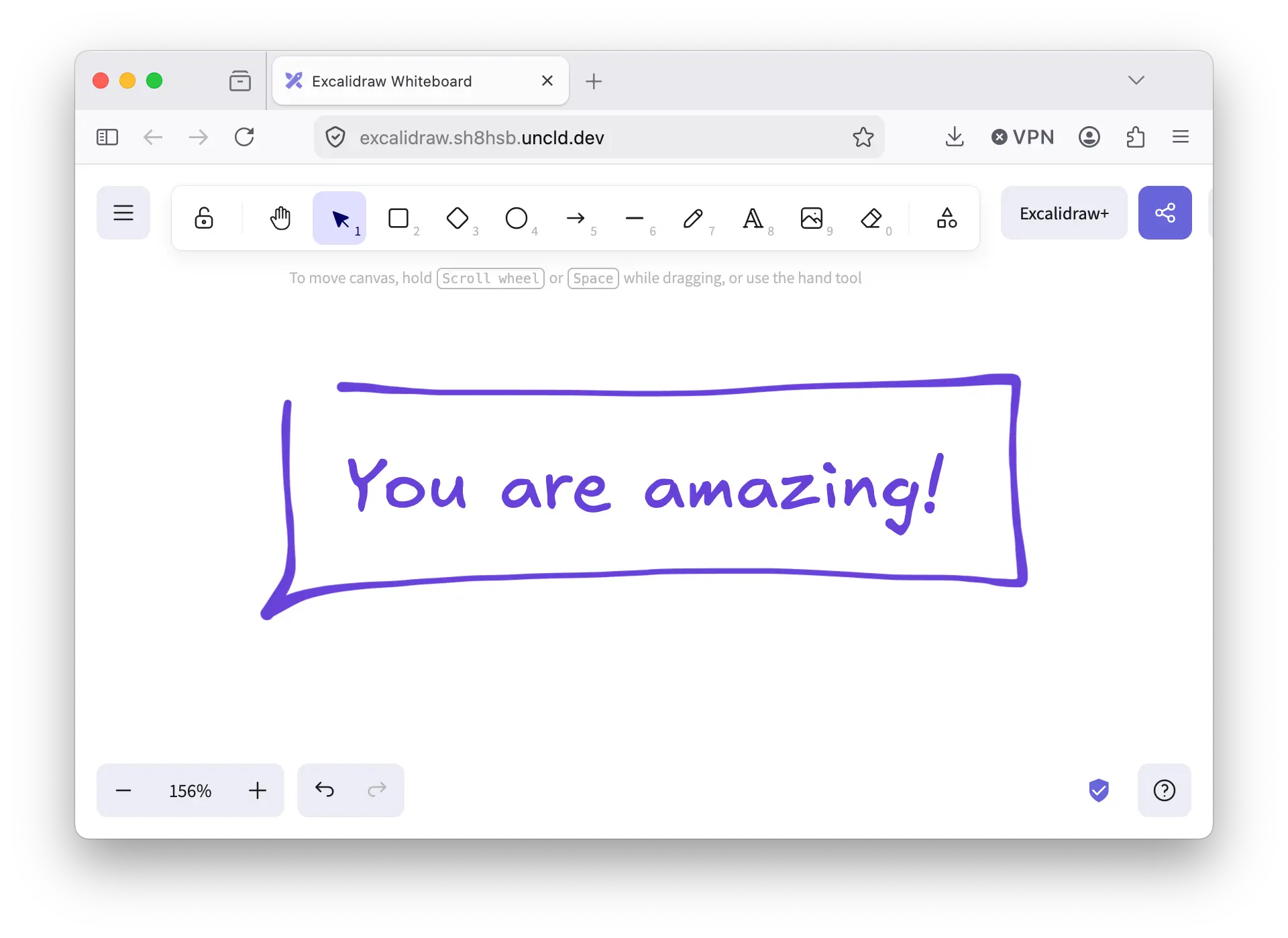
Open your browser and navigate to the URL shown in the endpoints. It may take a moment for Caddy to obtain a TLS
|
||||
certificate from Let's Encrypt. If it doesn't load immediately, wait a few seconds and try again.
|
||||
|
||||

|
||||
|
||||
|
||||
You now have:
|
||||
|
||||
@@ -231,6 +234,25 @@ You now have:
|
||||
- A **public URL** with **automatic HTTPS** you can share with your team and friends
|
||||
- **Full control over your data** — no analytics or tracking
|
||||
|
||||
## View service logs
|
||||
|
||||
Want to see what's happening inside your service? Use the `uc logs` command to view logs from the service container:
|
||||
|
||||
```shell
|
||||
uc logs excalidraw
|
||||
```
|
||||
|
||||
```
|
||||
Jul 14 10:53:05.910 machine-dc3c excalidraw/fde7a ::1 - - [14/Jul/2026:00:53:05 +0000] "GET / HTTP/1.1" 200 6843 "-" "Wget" "-"
|
||||
Jul 14 10:53:31.456 machine-dc3c excalidraw/fde7a 10.210.0.2 - - [14/Jul/2026:00:53:31 +0000] "GET /sw.js HTTP/1.1" 200 0 "-" "Mozilla/5.0 (Macintosh; Intel Mac OS X 10.15; rv:150.0) Gecko/20100101 Firefox/150.0"
|
||||
```
|
||||
|
||||
Add the `-f` flag to stream new logs in real-time. Press `Ctrl+C` to stop:
|
||||
|
||||
```shell
|
||||
uc logs excalidraw -f
|
||||
```
|
||||
|
||||
## Convert to Docker Compose format
|
||||
|
||||
Uncloud supports the [Compose file format](https://docs.docker.com/reference/compose-file/) for defining services. This
|
||||
@@ -249,9 +271,9 @@ services:
|
||||
|
||||
:::info note
|
||||
|
||||
The `x-ports` key is an Uncloud-specific extension to the Compose file format. It allows you to specify ports that
|
||||
should be published as HTTP(S) endpoints. Uncloud automatically configures the reverse proxy (Caddy) to route traffic to
|
||||
these ports.
|
||||
The [`x-ports`](../8-compose-file-reference/2-extensions.md#x-ports) key is an Uncloud-specific extension to the Compose
|
||||
file format. It allows you to specify ports that should be published as HTTP(S) endpoints. Uncloud automatically
|
||||
configures the reverse proxy (Caddy) to route traffic to these ports.
|
||||
|
||||
:::
|
||||
|
||||
@@ -270,27 +292,29 @@ We've successfully converted our deployment created with `uc run` to a Compose f
|
||||
|
||||
## Use your own domain
|
||||
|
||||
Want to use your own domain, for example, `excalidraw.example.com` instead of `excalidraw.7za6s7.uncld.dev`?
|
||||
Want to use your own domain, for example, `excalidraw.example.com` instead of `excalidraw.sh8hsb.uncld.dev`?
|
||||
|
||||
Add a CNAME record `excalidraw.example.com` in your DNS provider (Cloudflare, Namecheap, etc.) pointing to
|
||||
`excalidraw.7za6s7.uncld.dev`. Alternatively, you can add an A record pointing to your server's IP.
|
||||
`excalidraw.sh8hsb.uncld.dev`. Alternatively, you can add an A record pointing to your server's IP.
|
||||
|
||||
:::info note
|
||||
|
||||
These instructions set up your own domain **in addition to** the Uncloud managed DNS name
|
||||
`excalidraw.7za6s7.uncld.dev`.
|
||||
`excalidraw.sh8hsb.uncld.dev`.
|
||||
|
||||
If you want to avoid the managed service altogether, add `--no-dns` to your `uc machine init` command, and point an A
|
||||
DNS record to your server(s)'s IP(s).
|
||||
DNS record to your servers' IPs.
|
||||
|
||||
:::
|
||||
|
||||
Then update the published port `80/https` in `compose.yaml` to use your domain:
|
||||
|
||||
```yaml title="compose.yaml"
|
||||
...
|
||||
x-ports:
|
||||
- excalidraw.example.com:80/https
|
||||
services:
|
||||
excalidraw:
|
||||
image: excalidraw/excalidraw
|
||||
x-ports:
|
||||
- excalidraw.example.com:80/https
|
||||
```
|
||||
|
||||
Finally, deploy the changes:
|
||||
@@ -300,25 +324,32 @@ uc deploy
|
||||
```
|
||||
|
||||
```
|
||||
Deployment plan:
|
||||
- Deploy service [name=excalidraw]
|
||||
- machine-dc3c: Run container [image=excalidraw/excalidraw]
|
||||
- machine-dc3c: Remove container [name=excalidraw-azpc]
|
||||
Deployment plan
|
||||
|
||||
Do you want to continue?
|
||||
context: default
|
||||
|
||||
Choose [y/N]: y
|
||||
Chose: Yes!
|
||||
~ update service excalidraw
|
||||
│ image: excalidraw/excalidraw:latest
|
||||
│
|
||||
╰── +/- replace container excalidraw/fde7ac7f11ad on machine-dc3c
|
||||
|
||||
[+] Deploying services 2/2
|
||||
✔ Container excalidraw-0z12 on machine-dc3c Started 3.5s
|
||||
✔ Container excalidraw-azpc on machine-dc3c Removed 3.4s
|
||||
──────────────────────────────────────────
|
||||
1 replace (start-first) · across 1 machine
|
||||
|
||||
Proceed with deployment to default? [y/N] y
|
||||
|
||||
[+] Deploying to default 2/2
|
||||
✔ Container excalidraw-0z12 on machine-dc3c Healthy 30.6s
|
||||
✔ Container excalidraw/fde7ac7f11ad on machine-dc3c Removed 0.4s
|
||||
```
|
||||
|
||||
Notice how Uncloud performed a **zero-downtime deployment** — it started the new container with the updated
|
||||
configuration before removing the old one. Your service stayed available throughout the update.
|
||||
Uncloud prints a deployment plan and asks for confirmation before making any changes. The plan says it will replace the
|
||||
running container with a new one using the
|
||||
[`start-first` order](../4-guides/1-deployments/4-rolling-deployments.md#update-order). This means Uncloud starts the
|
||||
new container with the updated configuration, waits for it to become healthy, and only then removes the old one. Your
|
||||
service stays available throughout the update. That's a **zero-downtime deployment**.
|
||||
|
||||
Give it a moment for Caddy to obtain a TLS certificate, then visit https://excalidraw.example.com.
|
||||
Give it a moment for Caddy to obtain a TLS certificate, then visit https://excalidraw.example.com (use your own domain).
|
||||
|
||||
## Clean up
|
||||
|
||||
@@ -351,7 +382,7 @@ This command will:
|
||||
<summary>💡 Expand to see example output</summary>
|
||||
|
||||
```
|
||||
⚠️This script will uninstall Uncloud and remove ALL Uncloud managed containers on this machine.
|
||||
⚠️ This script will uninstall Uncloud and remove ALL Uncloud managed containers on this machine.
|
||||
The following actions will be performed:
|
||||
- Remove Uncloud systemd services
|
||||
- Remove Uncloud binaries and data
|
||||
@@ -361,20 +392,7 @@ The following actions will be performed:
|
||||
- Remove Uncloud WireGuard interface
|
||||
Do you want to proceed with uninstallation? [y/N] y
|
||||
⏳ Stopping systemd services...
|
||||
Removed "/etc/systemd/system/multi-user.target.wants/uncloud.service".
|
||||
The unit files have no installation config (WantedBy=, RequiredBy=, UpheldBy=,
|
||||
Also=, or Alias= settings in the [Install] section, and DefaultInstance= for
|
||||
template units). This means they are not meant to be enabled or disabled using systemctl.
|
||||
|
||||
Possible reasons for having these kinds of units are:
|
||||
• A unit may be statically enabled by being symlinked from another unit's
|
||||
.wants/, .requires/, or .upholds/ directory.
|
||||
• A unit's purpose may be to act as a helper for some other unit which has
|
||||
a requirement dependency on it.
|
||||
• A unit may be started when needed via activation (socket, path, timer,
|
||||
D-Bus, udev, scripted systemctl call, ...).
|
||||
• In case of template units, the unit is meant to be enabled with some
|
||||
instance name specified.
|
||||
Removed /etc/systemd/system/multi-user.target.wants/uncloud.service.
|
||||
✓ Systemd services stopped.
|
||||
⏳ Removing systemd service files...
|
||||
removed '/etc/systemd/system/uncloud.service'
|
||||
@@ -386,44 +404,61 @@ removed '/usr/local/bin/uncloudd'
|
||||
uncloud-corrosion
|
||||
✓ uncloud-corrosion container removed.
|
||||
⏳ Removing data and run directories...
|
||||
removed '/var/lib/uncloud/machine.db-wal'
|
||||
removed '/var/lib/uncloud/caddy/caddy/autosave.json'
|
||||
removed directory '/var/lib/uncloud/caddy/caddy'
|
||||
removed '/var/lib/uncloud/caddy/caddy.json'
|
||||
removed directory '/var/lib/uncloud/caddy'
|
||||
removed '/var/lib/uncloud/machine.json'
|
||||
removed '/var/lib/uncloud/machine.db-shm'
|
||||
removed '/var/lib/uncloud/corrosion/admin.sock'
|
||||
removed '/var/lib/uncloud/corrosion/config.toml'
|
||||
removed '/var/lib/uncloud/corrosion/subscriptions/b4e825113f1143e5b27715b62193a9f8/sub.sqlite-wal'
|
||||
removed '/var/lib/uncloud/corrosion/subscriptions/b4e825113f1143e5b27715b62193a9f8/sub.sqlite-shm'
|
||||
removed '/var/lib/uncloud/corrosion/subscriptions/b4e825113f1143e5b27715b62193a9f8/sub.sqlite'
|
||||
removed directory '/var/lib/uncloud/corrosion/subscriptions/b4e825113f1143e5b27715b62193a9f8'
|
||||
removed '/var/lib/uncloud/corrosion/subscriptions/5e04cbb20a2743c382cfbd4949922351/sub.sqlite'
|
||||
removed directory '/var/lib/uncloud/corrosion/subscriptions/5e04cbb20a2743c382cfbd4949922351'
|
||||
removed directory '/var/lib/uncloud/corrosion/subscriptions'
|
||||
removed '/var/lib/uncloud/corrosion/schema.sql'
|
||||
removed '/var/lib/uncloud/corrosion/store.db'
|
||||
removed directory '/var/lib/uncloud/corrosion'
|
||||
removed '/var/lib/uncloud/machine.db'
|
||||
removed '/var/lib/uncloud/corrosion/store.db'
|
||||
removed '/var/lib/uncloud/corrosion/subscriptions/754e24df40f8476389cf6dbfa7b542c8/sub.sqlite'
|
||||
removed directory '/var/lib/uncloud/corrosion/subscriptions/754e24df40f8476389cf6dbfa7b542c8'
|
||||
removed '/var/lib/uncloud/corrosion/subscriptions/125e6ada8eec4f3cad192e1890db55c2/sub.sqlite'
|
||||
removed directory '/var/lib/uncloud/corrosion/subscriptions/125e6ada8eec4f3cad192e1890db55c2'
|
||||
removed directory '/var/lib/uncloud/corrosion/subscriptions'
|
||||
removed '/var/lib/uncloud/corrosion/config.toml'
|
||||
removed '/var/lib/uncloud/corrosion/schema.sql'
|
||||
removed directory '/var/lib/uncloud/corrosion'
|
||||
removed '/var/lib/uncloud/machine.json'
|
||||
removed '/var/lib/uncloud/caddy/caddy.json'
|
||||
removed '/var/lib/uncloud/caddy/caddy/autosave.json'
|
||||
removed '/var/lib/uncloud/caddy/caddy/last_clean.json'
|
||||
removed directory '/var/lib/uncloud/caddy/caddy/locks'
|
||||
removed '/var/lib/uncloud/caddy/caddy/instance.uuid'
|
||||
removed '/var/lib/uncloud/caddy/caddy/acme/acme-staging-v02.api.letsencrypt.org-directory/users/default/default.json'
|
||||
removed '/var/lib/uncloud/caddy/caddy/acme/acme-staging-v02.api.letsencrypt.org-directory/users/default/default.key'
|
||||
removed directory '/var/lib/uncloud/caddy/caddy/acme/acme-staging-v02.api.letsencrypt.org-directory/users/default'
|
||||
removed directory '/var/lib/uncloud/caddy/caddy/acme/acme-staging-v02.api.letsencrypt.org-directory/users'
|
||||
removed directory '/var/lib/uncloud/caddy/caddy/acme/acme-staging-v02.api.letsencrypt.org-directory'
|
||||
removed '/var/lib/uncloud/caddy/caddy/acme/acme-v02.api.letsencrypt.org-directory/users/default/default.json'
|
||||
removed '/var/lib/uncloud/caddy/caddy/acme/acme-v02.api.letsencrypt.org-directory/users/default/default.key'
|
||||
removed directory '/var/lib/uncloud/caddy/caddy/acme/acme-v02.api.letsencrypt.org-directory/users/default'
|
||||
removed directory '/var/lib/uncloud/caddy/caddy/acme/acme-v02.api.letsencrypt.org-directory/users'
|
||||
removed directory '/var/lib/uncloud/caddy/caddy/acme/acme-v02.api.letsencrypt.org-directory/challenge_tokens'
|
||||
removed directory '/var/lib/uncloud/caddy/caddy/acme/acme-v02.api.letsencrypt.org-directory'
|
||||
removed directory '/var/lib/uncloud/caddy/caddy/acme'
|
||||
removed '/var/lib/uncloud/caddy/caddy/certificates/acme-v02.api.letsencrypt.org-directory/excalidraw.sh8hsb.uncld.dev/excalidraw.sh8hsb.uncld.dev.key'
|
||||
removed '/var/lib/uncloud/caddy/caddy/certificates/acme-v02.api.letsencrypt.org-directory/excalidraw.sh8hsb.uncld.dev/excalidraw.sh8hsb.uncld.dev.crt'
|
||||
removed '/var/lib/uncloud/caddy/caddy/certificates/acme-v02.api.letsencrypt.org-directory/excalidraw.sh8hsb.uncld.dev/excalidraw.sh8hsb.uncld.dev.json'
|
||||
removed directory '/var/lib/uncloud/caddy/caddy/certificates/acme-v02.api.letsencrypt.org-directory/excalidraw.sh8hsb.uncld.dev'
|
||||
removed directory '/var/lib/uncloud/caddy/caddy/certificates/acme-v02.api.letsencrypt.org-directory'
|
||||
removed directory '/var/lib/uncloud/caddy/caddy/certificates'
|
||||
removed directory '/var/lib/uncloud/caddy/caddy'
|
||||
removed '/var/lib/uncloud/caddy/Caddyfile'
|
||||
removed directory '/var/lib/uncloud/caddy'
|
||||
removed '/var/lib/uncloud/machine.db-wal'
|
||||
removed directory '/var/lib/uncloud'
|
||||
removed '/run/uncloud/caddy/admin.sock'
|
||||
removed directory '/run/uncloud/caddy'
|
||||
removed '/run/uncloud/corrosion/admin.sock'
|
||||
removed directory '/run/uncloud/corrosion'
|
||||
removed directory '/run/uncloud'
|
||||
✓ Data and run directories removed.
|
||||
⏳ Removing Linux user and group...
|
||||
✓ Linux user 'uncloud' removed.
|
||||
Linux group 'uncloud' does not exist or was already removed.
|
||||
⏳ Looking for Docker containers and network created by Uncloud...
|
||||
Found 4 Uncloud managed containers.
|
||||
Found 1 Uncloud managed containers.
|
||||
⏳ Stopping Uncloud managed containers...
|
||||
20613f6046d0
|
||||
1f1a65b78e93
|
||||
4300bde4a2b0
|
||||
053fdd57ec56
|
||||
b2eb9968e468
|
||||
⏳ Removing Uncloud managed containers...
|
||||
20613f6046d0
|
||||
1f1a65b78e93
|
||||
4300bde4a2b0
|
||||
053fdd57ec56
|
||||
b2eb9968e468
|
||||
✓ Uncloud managed containers stopped and removed.
|
||||
⏳ Removing Docker network uncloud...
|
||||
uncloud
|
||||
|
||||

|
Before Width: | Height: | Size: 389 KiB |
@@ -1,6 +1,6 @@
|
||||
# Connecting to a cluster
|
||||
|
||||
`uc` only needs to reach one machine to work with the entire cluster. That machine acts as an **entry point** and
|
||||
`uc` only needs to reach **one machine** to work with the entire cluster. That machine acts as an **entry point** and
|
||||
forwards requests to other machines as needed.
|
||||
|
||||
`uc` stores **cluster contexts** and **connection details** in a [configuration file](../../7-cli-config-reference.md)
|
||||
@@ -46,6 +46,27 @@ When you run a `uc` command, it determines which cluster to connect to using thi
|
||||
Once the context is resolved, `uc` tries each connection in the context's `connections` list in order until one
|
||||
succeeds.
|
||||
|
||||
## User permissions on the machine
|
||||
|
||||
When `uc` connects to a machine over SSH, it communicates with the Uncloud daemon through the Unix socket
|
||||
`/run/uncloud/uncloud.sock` on that machine. The daemon restricts access to the socket to the `root` user and members
|
||||
of the `uncloud` Linux group. This means your SSH user must be either `root` or a member of the `uncloud` group.
|
||||
|
||||
In most cases you don't need to set this up manually. When you initialise or add a machine with a non-root user,
|
||||
`uc machine init` and `uc machine add` automatically add that user to the `uncloud` group during installation.
|
||||
|
||||
If you want to connect with a different non-root user later, add them to the group on the machine:
|
||||
|
||||
```shell
|
||||
sudo usermod -aG uncloud <username>
|
||||
```
|
||||
|
||||
The group change only applies to new SSH sessions. If `uc` still fails with a permission denied error after adding the
|
||||
user, close any long-running SSH connections to the machine (for example, SSH ControlMaster sessions) and try again.
|
||||
|
||||
The same requirement applies when running `uc` locally on a cluster machine with a `unix://` connection. The local user
|
||||
must be `root` or a member of the `uncloud` group.
|
||||
|
||||
## Global flags and environment variables
|
||||
|
||||
These flags are available on every `uc` command. They can also be set with an environment variable. The flag takes
|
||||
|
||||
@@ -17,7 +17,7 @@ uc run -p app.example.com:8000/https app:latest
|
||||
|
||||
```
|
||||
[+] Running service app-mwng (replicated mode) 1/1
|
||||
✔ Container app-mwng-6lub on machine-fnr9 Started
|
||||
✔ Container app-mwng-6lub on machine-fnr9 Running
|
||||
|
||||
app-mwng endpoints:
|
||||
• https://app.example.com → :8000
|
||||
|
||||
@@ -45,9 +45,11 @@ If you rely on a specific Compose feature that is not supported by Uncloud, plea
|
||||
| `secrets` | ⚠️ Limited | Reference secrets in `environment`, see [Secrets](../3-concepts/8-secrets.md). File mounts not supported |
|
||||
| `security_opt` | ❌ Not supported | |
|
||||
| `shm_size` | ✅ Supported | Shared memory size |
|
||||
| `stdin_open` | ✅ Supported | Allocate standard input and keep it open |
|
||||
| `stop_grace_period` | ✅ Supported | Time to wait after SIGTERM before SIGKILL |
|
||||
| `storage_opt` | ❌ Not supported | |
|
||||
| `sysctls` | ✅ Supported | Namespaced kernel parameters |
|
||||
| `tty` | ✅ Supported | Allocate a pseudo-TTY and connect the container's standard streams to it |
|
||||
| `ulimits` | ✅ Supported | Resource limits |
|
||||
| `user` | ✅ Supported | Set container user |
|
||||
| `volumes` | ✅ Supported | Named volumes, bind mounts, tmpfs |
|
||||
|
||||
@@ -12,7 +12,19 @@ import {themes as prismThemes} from 'prism-react-renderer';
|
||||
const config = {
|
||||
title: 'Uncloud',
|
||||
tagline: 'Self-host and scale web apps without Kubernetes complexity',
|
||||
favicon: 'img/favicon.png',
|
||||
// Use the SVG logo as the primary favicon with a PNG fallback to match the landing pages.
|
||||
favicon: 'img/logo.svg',
|
||||
headTags: [
|
||||
{
|
||||
tagName: 'link',
|
||||
attributes: {
|
||||
rel: 'alternate icon',
|
||||
type: 'image/png',
|
||||
href: '/img/favicon.png',
|
||||
sizes: '96x96',
|
||||
},
|
||||
},
|
||||
],
|
||||
|
||||
// Set the production url of your site here
|
||||
url: 'https://uncloud.run',
|
||||
|
||||
@@ -689,7 +689,7 @@
|
||||
</svg>
|
||||
</summary>
|
||||
<p class="text-zinc-500 leading-relaxed pb-5">
|
||||
No. <a class="underline hover:text-zinc-900" href="/">Uncloud</a> is open source
|
||||
No, <a class="underline hover:text-zinc-900" href="/">Uncloud</a> is open source
|
||||
and fully functional on its own without Hub. You can use the CLI to manage your
|
||||
clusters and deploy your apps across servers from Compose files. You keep full
|
||||
control over your servers. Hub adds a web UI and an observability stack on top so
|
||||
@@ -708,9 +708,12 @@
|
||||
</svg>
|
||||
</summary>
|
||||
<p class="text-zinc-500 leading-relaxed pb-5">
|
||||
No, and no point pretending otherwise. Uncloud, the orchestrator, is Apache 2.0. Hub
|
||||
is a managed service built on top, and it's how we plan to fund Uncloud's full-time
|
||||
development.
|
||||
Not at the moment. Hub is a managed service built on top of Uncloud, and it's how
|
||||
we plan to fund Uncloud's full-time development. Our principle is that everything
|
||||
Uncloud needs on your servers is open source, starting with Uncloud itself under
|
||||
Apache 2.0. Your cluster never depends on closed code to keep running. If enough
|
||||
people want to run Hub on their own infrastructure, a paid self-hosted license is
|
||||
on the table.
|
||||
</p>
|
||||
</details>
|
||||
|
||||
|
||||

|
Before Width: | Height: | Size: 1.5 KiB After Width: | Height: | Size: 875 B |

|
Before Width: | Height: | Size: 1.2 KiB After Width: | Height: | Size: 3.0 KiB |

|
Before Width: | Height: | Size: 4.9 KiB |

|
Before Width: | Height: | Size: 56 KiB After Width: | Height: | Size: 56 KiB |
@@ -140,7 +140,7 @@
|
||||
<div class="max-w-xs mx-auto sm:max-w-none sm:inline-flex sm:justify-center space-y-4 sm:space-y-0 sm:space-x-4">
|
||||
<div>
|
||||
<a class="btn text-zinc-100 bg-zinc-900 hover:bg-zinc-800 w-full shadow flex items-center justify-center"
|
||||
href="https://github.com/psviderski/uncloud/?tab=readme-ov-file#-quick-start">
|
||||
href="/docs/getting-started/deploy-demo-app">
|
||||
<svg class="w-5 h-5 mr-2" xmlns="http://www.w3.org/2000/svg" viewBox="0 0 24 24"
|
||||
fill="none" stroke="currentColor" stroke-width="2" stroke-linecap="round"
|
||||
stroke-linejoin="round">
|
||||
@@ -738,10 +738,6 @@ prod-3 201.45.91.123:51820 1m56s ago 11ms 5.12MB 9.34MB
|
||||
<a class="text-sm font-medium text-violet-700 hover:text-violet-900 transition"
|
||||
href="/hub#early-access">Get early access →</a>
|
||||
</div>
|
||||
<p class="mt-5 text-sm text-zinc-500">
|
||||
Hub is how we plan to fund Uncloud's full-time development.<br>
|
||||
Uncloud itself stays Apache 2.0 and works fully without Hub.
|
||||
</p>
|
||||
</div>
|
||||
|
||||
<div class="lg:col-start-1 lg:row-start-1 rounded-xl overflow-hidden border border-zinc-200 shadow-2xl shadow-zinc-950/10">
|
||||
@@ -825,6 +821,49 @@ prod-3 201.45.91.123:51820 1m56s ago 11ms 5.12MB 9.34MB
|
||||
There are no agents to install and no pipelines to migrate.
|
||||
</p>
|
||||
</details>
|
||||
|
||||
<details class="group">
|
||||
<summary
|
||||
class="flex items-center justify-between gap-4 py-5 cursor-pointer list-none [&::-webkit-details-marker]:hidden font-inter-tight font-semibold text-zinc-900">
|
||||
<span>Do I need Hub to use Uncloud?</span>
|
||||
<svg class="w-5 h-5 shrink-0 text-zinc-400 transition-transform duration-200 group-open:rotate-45"
|
||||
fill="none" stroke="currentColor" stroke-width="2" viewBox="0 0 24 24"
|
||||
aria-hidden="true">
|
||||
<path stroke-linecap="round" stroke-linejoin="round" d="M12 5v14m-7-7h14"/>
|
||||
</svg>
|
||||
</summary>
|
||||
<p class="text-zinc-500 leading-relaxed pb-5">
|
||||
No, Uncloud is open source and fully functional on its own without Hub. You can use
|
||||
the CLI to manage your clusters and deploy your apps across servers from Compose
|
||||
files. You keep full control over your servers. Hub adds a web UI and an
|
||||
observability stack on top so you don't have to build and manage one yourself.
|
||||
</p>
|
||||
</details>
|
||||
</div>
|
||||
</div>
|
||||
</div>
|
||||
</div>
|
||||
</section>
|
||||
|
||||
<!-- Newsletter subscription -->
|
||||
<section class="relative bg-white">
|
||||
<div class="py-12 md:py-20">
|
||||
<div class="max-w-6xl mx-auto px-4 sm:px-6">
|
||||
<div class="max-w-2xl mx-auto text-center">
|
||||
<h2 class="font-inter-tight text-3xl md:text-4xl font-bold text-zinc-900 mb-4">
|
||||
Follow the development journey
|
||||
</h2>
|
||||
<p class="text-lg text-zinc-500">
|
||||
Subscribe to get early insights into new features.
|
||||
See <a class="font-medium text-zinc-600 underline decoration-zinc-300 underline-offset-2 hover:text-zinc-900 hover:decoration-zinc-400 transition-colors"
|
||||
href="https://psviderski.substack.com/" target="_blank" rel="noopener">previous
|
||||
newsletters</a>.
|
||||
</p>
|
||||
<div class="mt-6 md:mt-8 flex justify-center">
|
||||
<iframe src="https://psviderski.substack.com/embed?transparent=true" width="480"
|
||||
height="160" title="Subscribe to the Uncloud newsletter" class="w-full max-w-[480px]"
|
||||
style="border:none; background:transparent;" frameborder="0"
|
||||
scrolling="no"></iframe>
|
||||
</div>
|
||||
</div>
|
||||
</div>
|
||||
@@ -869,21 +908,6 @@ prod-3 201.45.91.123:51820 1m56s ago 11ms 5.12MB 9.34MB
|
||||
</div>
|
||||
</div>
|
||||
|
||||
<!-- Newsletter subscription -->
|
||||
<div class="mt-12 md:mt-16">
|
||||
<p class="text-zinc-400 mb-4">
|
||||
Subscribe to follow the development journey and get early insights into new features.<br>
|
||||
See <a href="https://psviderski.substack.com/" target="_blank" rel="noopener"
|
||||
class="text-zinc-200 underline decoration-zinc-500 underline-offset-2 hover:text-zinc-100 hover:decoration-zinc-300 transition-colors">previous
|
||||
newsletters</a>.
|
||||
</p>
|
||||
<div class="flex justify-center">
|
||||
<iframe src="https://psviderski.substack.com/embed?transparent=true" width="480"
|
||||
height="150" title="Subscribe to the Uncloud newsletter"
|
||||
style="border:none; background:transparent;" frameborder="0"
|
||||
scrolling="no"></iframe>
|
||||
</div>
|
||||
</div>
|
||||
</div>
|
||||
</div>
|
||||
</section>
|
||||
|
||||
@@ -1348,6 +1348,10 @@ input[type="search"]::-webkit-search-results-decoration {
|
||||
display: inline-flex;
|
||||
}
|
||||
|
||||
.table{
|
||||
display: table;
|
||||
}
|
||||
|
||||
.grid{
|
||||
display: grid;
|
||||
}
|
||||
@@ -1468,6 +1472,10 @@ input[type="search"]::-webkit-search-results-decoration {
|
||||
max-width: 72rem;
|
||||
}
|
||||
|
||||
.max-w-\[480px\]{
|
||||
max-width: 480px;
|
||||
}
|
||||
|
||||
.max-w-lg{
|
||||
max-width: 32rem;
|
||||
}
|
||||
@@ -2376,10 +2384,6 @@ input[type="search"]::-webkit-search-results-decoration {
|
||||
text-decoration-color: #a1a1aa;
|
||||
}
|
||||
|
||||
.decoration-zinc-500{
|
||||
text-decoration-color: #71717a;
|
||||
}
|
||||
|
||||
.underline-offset-2{
|
||||
text-underline-offset: 2px;
|
||||
}
|
||||
@@ -2735,10 +2739,6 @@ html {
|
||||
text-decoration-color: #f4f4f5;
|
||||
}
|
||||
|
||||
.hover\:decoration-zinc-300:hover{
|
||||
text-decoration-color: #d4d4d8;
|
||||
}
|
||||
|
||||
.hover\:decoration-zinc-400:hover{
|
||||
text-decoration-color: #a1a1aa;
|
||||
}
|
||||
@@ -2963,8 +2963,8 @@ html {
|
||||
margin-top: 3.5rem;
|
||||
}
|
||||
|
||||
.md\:mt-16{
|
||||
margin-top: 4rem;
|
||||
.md\:mt-8{
|
||||
margin-top: 2rem;
|
||||
}
|
||||
|
||||
.md\:block{
|
||||
|
||||

|
Before Width: | Height: | Size: 1.2 KiB After Width: | Height: | Size: 3.0 KiB |

|
Before Width: | Height: | Size: 88 KiB After Width: | Height: | Size: 25 KiB |